


Fly agaric
Fly agaric
Couldn't load pickup availability
Free delivery on orders over €70
Free delivery on orders over €70
Treat yourself without extra charges. Free delivery for any order of €70 or more via Mondial Relay.
Perfect gift
Perfect gift
Offer an original, durable and characterful product. A perfect idea to surprise your loved ones with a unique creation by Loufoque.
Responsive customer service
Responsive customer service
Questions? Our team will get back to you within 24 hours to assist you before and after your order.
| 2 to 4 players | 30 min | 10 years and up |
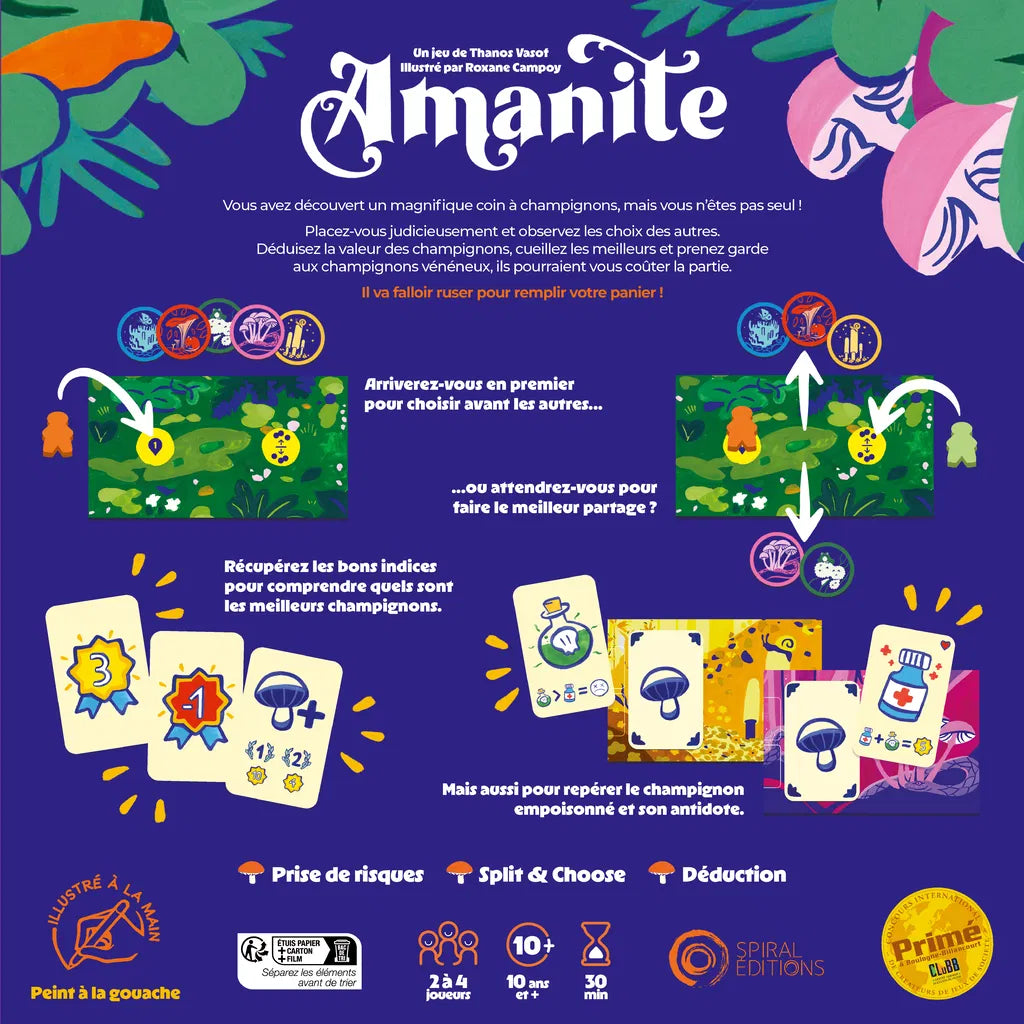
Immerse yourself in the bucolic and subtle world of Amanite: a board game where every mushroom-picking turn is tense! You play as a mushroom picker, wandering through the forest, collecting specimens... but beware: some will be delicious, others deadly.
Combining deduction, risk-taking, and observation of opponents, this family game for 2-4 players promises fast-paced (around 30 minutes) and highly interactive games. Accessible yet profound, Amanite will quickly become a must-have for fans of light strategy.


How to play Amanite?
Game Setup
Before starting, each player takes their assigned wooden meeples and places the "Forest" tiles in the center or in an agreed-upon arrangement. The cloth bag containing the mushroom and pig tokens is set up, and the "Clue" and "Value" cards are inserted according to the rules.
The player designated as "first player" receives the corresponding token. The board or play area is ready, players know the (quick) rules, and the game can begin.
Gameplay outline
The game consists of 3 rounds.
In each round, players will take turns choosing or placing a meeple on a gathering area, using the clue cards they have or must choose, and then collecting mushrooms based on the results.
The core of the mechanic relies on deduction: some mushrooms earn points, while others are poisonous and can make you lose big. You must observe not only your clues but also the actions (and hesitations) of other players to refine your choices.
Win/Loss Condition
At the end of the 3rd round, victory points are counted based on the mushroom tokens collected. Be careful: if you have collected too many poisonous mushrooms or pigs, you may be eliminated or see your points drop drastically, preventing you from winning the game. The player with the highest "bonus" point total while avoiding elimination wins.
Our Tips for Winning
-
Choose your clues carefully to guide your harvest
Each clue card is a small piece of the puzzle: don't select them at random. Assess your position relative to other players and choose a clue that will open up a good mushroom spot for you while depriving your opponent.
-
Observe the choices of other pickers carefully
Amanite’s strength lies in observation. If an opponent hesitates or avoids certain areas, this may indicate a dangerous mushroom. Use this to your advantage to avoid costly mistakes.
-
Take a calculated risk rather than playing it safe
Playing too cautiously can put you behind. If you have good clues or your opponents' positions are weak, try a high-risk move: a "big bonus" mushroom can turn the tide of the game.
FAQ – All about Amanita
Does the number of players heavily influence the strategy?
Yes. With 2 players, every opponent's choice is extremely visible, making deduction more straightforward. With 4 players, interaction is denser and "safe zones" shrink, which makes analysis more complex.
Can multiple scoring modes be combined in a game?
Absolutely. The game offers different types of scoring that can be combined to vary gameplay. This adds replayability and modifies strategic priorities.
What is the importance of the "cloth bag" and tokens in the mechanics?
The bag introduces a random and visual element: drawing mushroom or pig tokens adds a small "physical" risk to each harvest, increasing the tension and atmosphere
Is the gathering theme purely cosmetic or does it impact the mechanics?
The theme is well integrated: the deduction and risk mechanics directly evoke the idea of going into the forest, picking unknown mushrooms, and having to guess which ones are good or dangerous. The components and artwork reinforce this feeling.