


Field of Honour
Field of Honour
Couldn't load pickup availability
Free delivery on orders over €70
Free delivery on orders over €70
Treat yourself without extra charges. Free delivery for any order of €70 or more via Mondial Relay.
Perfect gift
Perfect gift
Offer an original, durable and characterful product. A perfect idea to surprise your loved ones with a unique creation by Loufoque.
Responsive customer service
Responsive customer service
Questions? Our team will get back to you within 24 hours to assist you before and after your order.
| 2 or 4 players | 45 min | Ages 14+ |
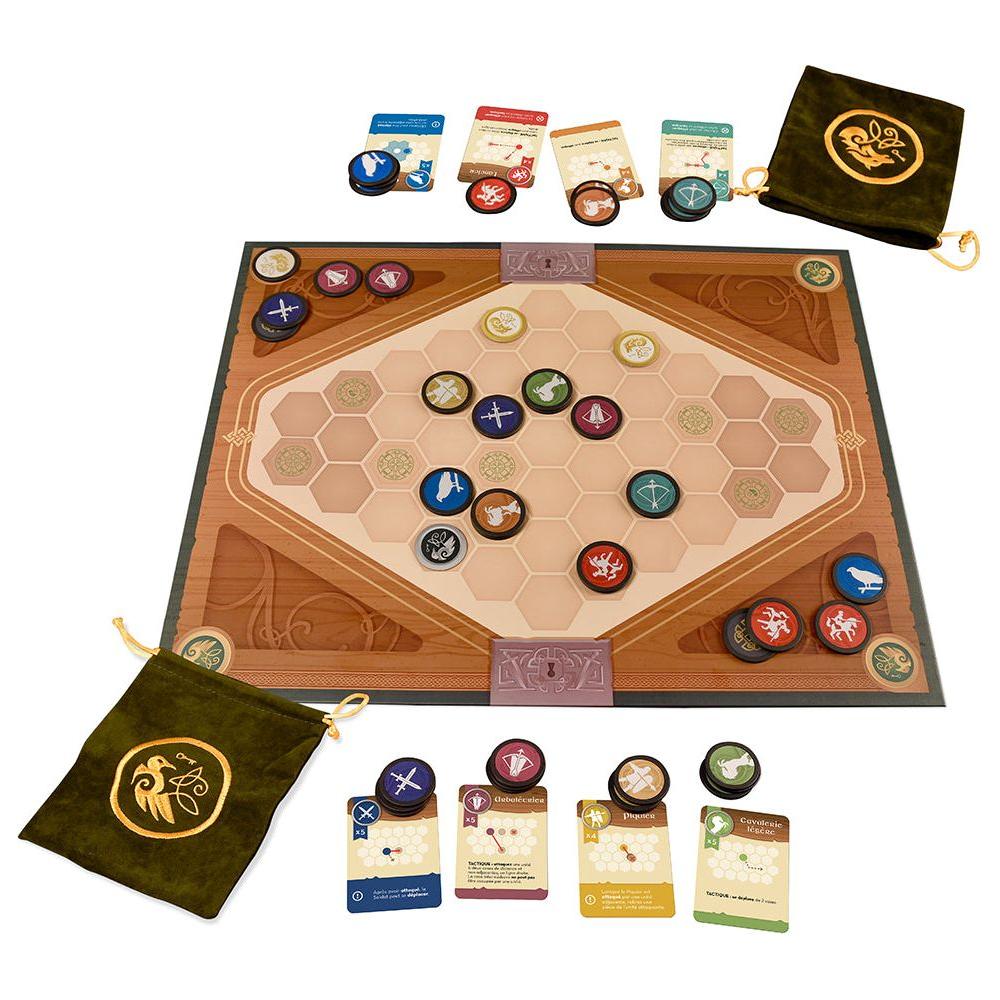
Champ d'Honneur is a wargame of bag-building and area control for 2 or 4 players, designed by David Thompson and Trevor Benjamin and published by Gigamic. Each player embodies a medieval warlord leading an army of 4 units with unique tactics — soldiers, knights, crossbowmen, cavalry, and many others — drawn each turn from a velvet bag. The elegant abstraction of the poker chips engraved with each unit's coat of arms evokes Chess in its tactical depth, but stands out with its draft-based army composition mechanic and unprecedented combos in every game. Crowned Tric Trac d'Or 2020 for Best Two-Player Game, Champ d'Honneur has established itself as the benchmark for accessible tactical duels.

How to play Honorfield?
Game Setup
- Place the game boardin the center of the table with its spaces and neutral control points.
- Each player receives 4 Unit cards— either drafted or drawn randomly depending on the setup — and the corresponding 78 tokens, which they place in front of them.
- Assemble your bagby putting 1 token of each unitfrom your army into it. The rest form your off-bag reserve.
- Each player also takes their control markers(flags) and places their first unitson their starting spaces according to the initiative rules.
- The player with initiative begins.
Gameplay outline
Each turn proceeds in two phases:
- Draw: Draw 3 tokensfrom your bag. Each token represents a military unit—its face indicates the unit type. The tokens drawn define your action options for that turn.
- Actions: For each token drawn, choose 1 action out of 4:Deploy: Place a token of this unit from your reserve onto the board, on a square you control.Reinforce: Add a token of this unit to a unit already in play to give it an additional level.Maneuver: Move one of your units on the board according to its specific movement rules.Attack: Attack an adjacent enemy unit. The losing unit loses a token—if it has no more, it is removed from the game.Recruit: Add a token of this unit to your discard pile, which will return to your bag during the next shuffle.
Each unit also has a passive special ability: the Spearman removes a token from its attacker, the Monk Soldier grants an additional action after a successful attack, the Knight can only be targeted by reinforced units, etc.
Win/Loss Condition
The first player (or team of 4) to place all their control markerson the key points on the board wins the game. Control a space by capturing it with a unit and having no adjacent enemies.
Our Tips for Winning
-
Draft units that create synergies, not just the strongest ones individually
Some units are average on their own but formidable when combined. The Soldier Monk chains actions when attacking — paired with the hard-to-attack Knight, the duo is devastating. Before drafting, think of your army as a coherent system, not a collection of isolated units.
-
Manage your bag so you never miss out on key items
Bag-building creates constant tension:recruiting enriches your bagbut dilutes your probabilities. Avoid recruiting heavily at the start of the game — you risk drawing the wrong pieces at the wrong times. Recruit selectively, only when your bag is empty or unbalanced.
-
Strengthen before attacking to maximize resistance
A reinforced two-tier unit can take two hits before being destroyed. Always reinforceyour frontline units before throwing them into battle. A single-tier unit disappears too quickly to be effective in the long run.
FAQ – All About Champ d'Honneur
Is Field of Honor really like Chess?
Comparisons are frequent and partially justified: area control, taking positions, controlling squares, tactical depth. But the bag-building mechanic, army composition through drafting, the unique abilities of each unit, and in-game recruitment make it a radically different game — more accessible, more varied, and less deterministic.
Do the 16 different units truly generate replayability?
Very much so. The 16 available units allow for a considerable number of 4-unit army combinations. In practice, each game with a different armycreates new tactical dynamics. Experienced players eventually develop preferences and counter-strategies for each composition.
Are there any extensions available?
Yes, three expansions are available:Noblesse (Nobility), Siège (Siege), andFélonie (Felony). Each adds new units with unique abilities and expands the drafting options without overcomplicating the basic rules. They are all compatible with each other.
Is the 4-player game with teams of 2 as good as the 2-player duel?
The experience is different but just as satisfying. With 4 players, team coordinationbecomes an additional challenge: communicating your strategy without revealing your hand to your opponent is a challenge in itself. Some players even prefer this configuration for the social dimension it adds.