


Codenames Pictures
Codenames Pictures
Couldn't load pickup availability
Free delivery on orders over €70
Free delivery on orders over €70
Treat yourself without extra charges. Free delivery for any order of €70 or more via Mondial Relay.
Perfect gift
Perfect gift
Offer an original, durable and characterful product. A perfect idea to surprise your loved ones with a unique creation by Loufoque.
Responsive customer service
Responsive customer service
Questions? Our team will get back to you within 24 hours to assist you before and after your order.
| 2 to 8 players | 15 min | Ages 10+ |
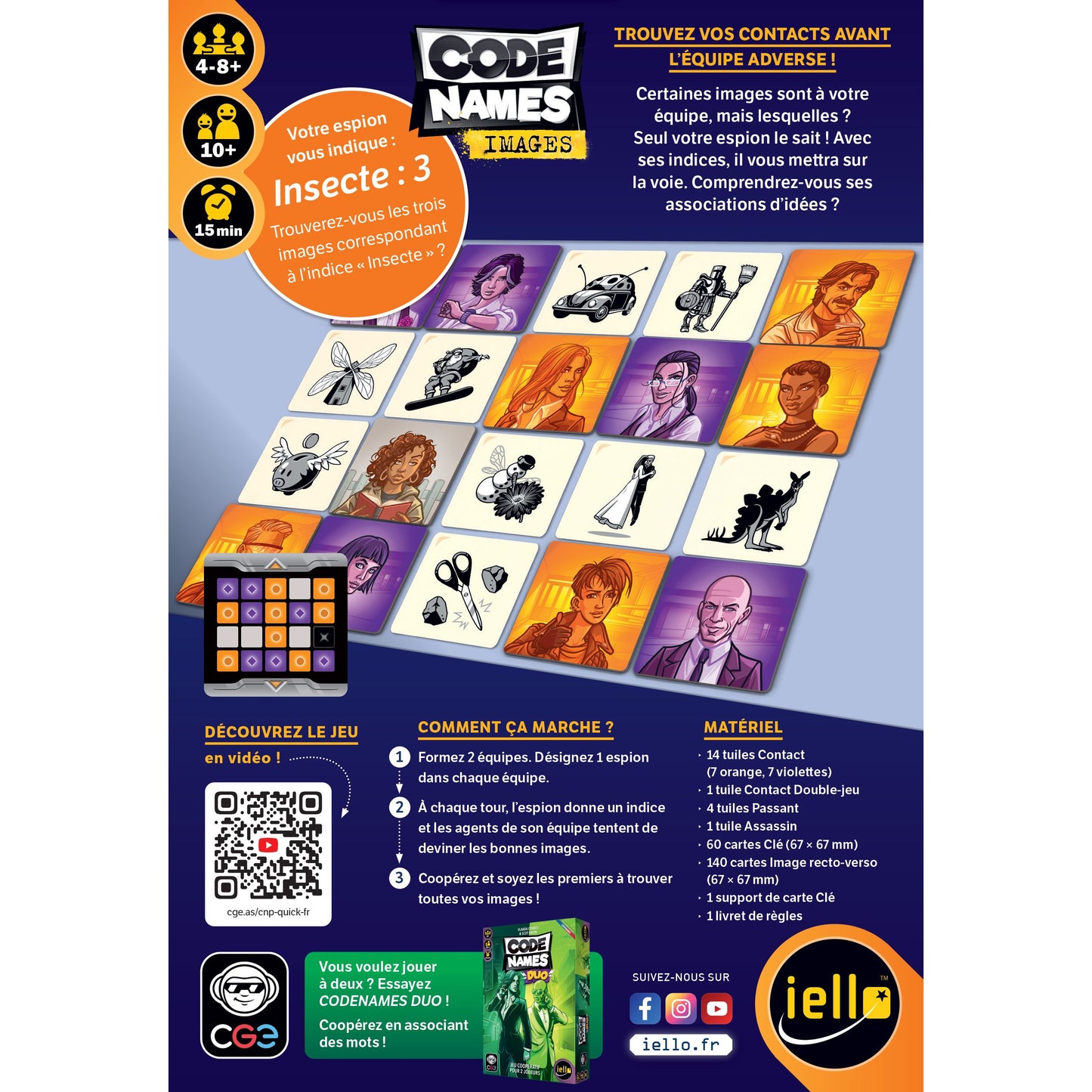
Codenames Duet is the illustrated version of the famous Codenames by Vlaada Chvátil, published by IELLO. The principle remains the same — two teams of spies compete to have their contacts guessed before the opponent — but the words are here replaced by surrealistic, poetic and ambiguous images that offer a radically different freedom of association. Where words are precise, illustrations open up an infinite field of interpretation. A grid of 20 cards instead of 25, potentially broader and more creative clues, and enhanced accessibility for younger players or non-French speakers. A standalone Codenames, compatible with all versions of the range.

How to play Codenames Duet?
Game Setup
- Form a grid of 20 Picture cardsin 5 columns and 4 rows in the center of the table, with the illustrated sides visible to everyone.
- Divide the players into two teams(red and blue) and designate a Spymasterin each team.
- The two Spymasters sit side by side, facing their respective agents, and draw a Key cardwhich they place on the stand between them — invisible to the agents. It indicates which pictures belong to each team, which are neutral, and which one is the Assassin.
- The color bordering the Key carddesignates the team that starts. This team receives the Extra tile— an additional picture to be guessed (7 pictures versus 6 for the team playing second).
- Distribute the Identity tiles of each color in front of the corresponding Spymaster.
Gameplay outline
Teams take turns. During each turn:
- The Spymastergives one wordfollowed by a number indicating how many images on the grid that clue refers to. The clue can refer to any visible aspect of the image—an object, a color, an emotion, a concept, an action, an artistic style. Puns and homonyms are allowed. Forbidden: giving the position of the image ("on the left"), its brightness characteristics ("dark"), or any clue unrelated to the visual content.
- The Operativesdiscuss among themselves and point to images one by one, in any order. For each image pointed to:
Your team's image: the corresponding Identity tile covers it, and you can continue pointing.
Opponent's or neutral image: the corresponding tile covers it and your turn ends immediately.
The Assassin: immediate defeat for your team.
- The Operatives can stop voluntarilyafter having guessed at least one correct image—without going up to the maximum indicated. If the clue was risky, sometimes it's better not to take chances.
- If the contract is fully completed, the team gets one bonus guess.
Win/Loss Condition
The first team to cover all of its images with its Identity tiles wins the game. A team immediately loses if it points to the Assassin.
Our Tips for Winning
-
Exploit the polysemy of images for clues that cover multiple cards
The illustrations in Codenames Pictures are intentionally ambiguous and rich in detail. A starry sky background, a character wearing a hat, a particular texture — a single visual element can connect two or three pictures in unexpected ways. Take the time to observe each card before formulating your clue.
-
Beware of adverse images that seem too close to your cue
Before giving your clue, always checkif images of the opposing team or the Assassin are not too semantically close. A brilliant association that makes 3 cards guess loses all its interest if it also leads to an enemy image.
-
Stop before you go too far
If your operatives have correctly guessed the first pictures of your clue but are hesitant about the last one, let them pass voluntarily. The bonus guess is tempting, but a neutral or adverse covered picture ends your turn — and the risk of uncovering the Assassin is always present.
FAQ – All about Codenames Pictures
Is Codenames Duet easier or harder than classic Codenames?
Opinions are divided. Images often offer more hooksthan a single word — colors, shapes, emotions, secondary objects — which facilitates clues covering multiple cards. However, since interpretation is subjective, misunderstandings between the Spymaster and agents are more frequent. The difficulty is different, not necessarily greater.
Can a directly visible object in the image be cited as a clue?
Yes, it's even the basis of the game. Unlike classic Codenames where giving a word present on the card is forbidden, here the clue must refer to what you seein the image. You can therefore cite an animal, an object, a dominant color, or an illustrated concept.
Do the 140 Image cards generate enough replayability?
Yes. With 60 Key cards and 140 Image cards, the number of possible grids is very high. Moreover, since the cards are double-sided, some images show variations from one side to the other, further enriching the variety of games.
Is the game really more kid-friendly than classic Codenames?
Yes. The absence of reading makes the game playable with children as young as 6-7 years old when accompaniedby an adult, and fully autonomously from 10 years old. The images also have a universal appeal that transcends language barriers.