


Colt Express: Anniversary Edition
Colt Express: Anniversary Edition
Couldn't load pickup availability
Free delivery on orders over €70
Free delivery on orders over €70
Treat yourself without extra charges. Free delivery for any order of €70 or more via Mondial Relay.
Perfect gift
Perfect gift
Offer an original, durable and characterful product. A perfect idea to surprise your loved ones with a unique creation by Loufoque.
Responsive customer service
Responsive customer service
Questions? Our team will get back to you within 24 hours to assist you before and after your order.
| 2 to 6 players | 40 min | Ages 10+ |
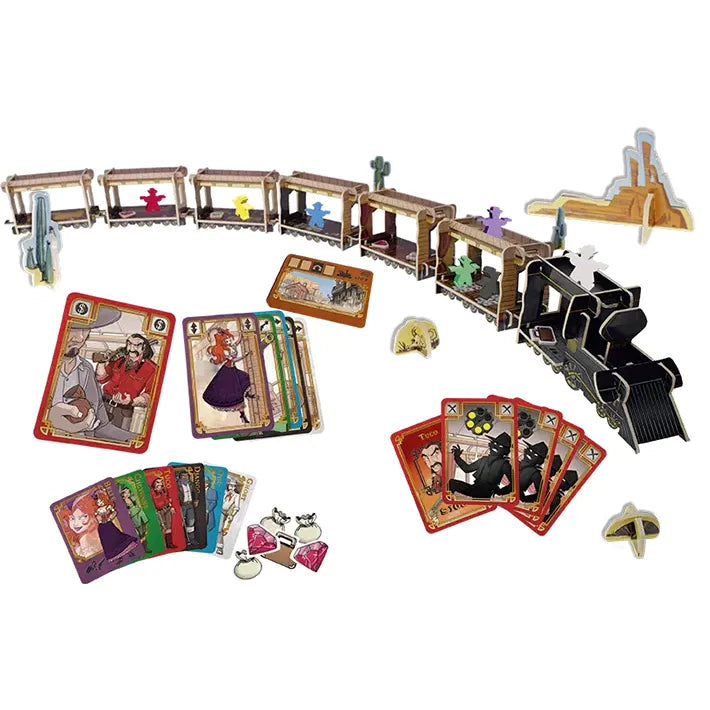
Colt Express is an action programming and atmosphere game for 2 to 6 players, designed by Christophe Raimbault, illustrated by Jordi Valbuena, and published by Ludonaute. Crowned Spiel des Jahres 2015, it plunges players into the American West of 1899: six desperados simultaneously attack a train, each trying to fill their pockets before arriving at the station, while shooting at their rivals and avoiding the Marshall. The game's stroke of genius: all actions are programmed in advance on a common pile — and nothing ever goes as planned. Chaos, nasty surprises, and laughter are guaranteed, especially with 5 or 6 players.


How to Play Colt Express?
Game Setup
- Assemble the 3D trainin the center of the table: as many cars as there are players, plus the locomotive. Each car comes with its interior and roof.
- Distribute the sacks, gems, and briefcasesinto the cars according to the number of players indicated in the booklet.
- Place the Marshal pawnin the locomotive.
- Each player chooses their bandit character—Belle, Cheyenne, Django, Doc, Ghost, Mei, or Tuco—and receives their corresponding 6 Action cards(Doc takes 7), their Character sheetwith their special power, and their starting bag of $250.
- Arrange 4 Round cardsand 1 End cardin order. Each Round card indicates the number of programming turns and special conditions (tunnel, passenger attack, reversed order...).
- Place the bandits in the last two cars according to their turn order.
Gameplay outline
The game is played in 5 rounds, each with two phases:
Phase 1 — Programming:
- Flip the current Round card: it indicates the number of turns and whether cards are played face-up(actions known to all) or face-down(like in a tunnel — no one knows what you're programming).
- In turn order, each player plays 1 Action card(or 2 in some cases) onto a common central pile— visible to all if face-up, mysterious if face-down. Repeat for as many turns as the Round card indicates.
- At any time, instead of playing a card, a player can exchange 3 cards from their handfor 3 new ones from their draw pile.
Phase 2 — Resolution:
- The cards in the common pile are flipped and resolved in order, from bottom to top. The 6 possible actions are:
Move: move one car inside (1 car) or on the roof (1 to 3 cars).
Change Level: go up to the roof or down inside.
Steal: collect loot present in your car. If there is none, the action is wasted.
Shoot: give a Bulletcard to a bandit in an adjacent car or in line of sight on the roof. Bullets are shuffled into the touched player's deck and dilutetheir future hands of cards.
Punch: make a bandit move back into an adjacent car, losing a piece of loot to the floor.
Move the Marshal: move the Marshal one car. If he encounters a bandit, the bandit receives a neutral Bullet and is expelled to the roof.
- At the end of each round, a special eventmay be triggered according to the Round card (Marshal's shot, passenger rebellion, bandit movement...). Played cards remain in each player's discard pile and hands are refilled to 6 cards— including bullets — for the next round.
Win/Loss Condition
After the 5th round, each player counts the total value of their loot. The bandit who inflicted the most bullet wounds on their opponents receives the title of Sharpshooterand wins an additional $1,000. The richest player wins the game.
Our Tips for Winning
-
Memorize the cards that you and the others have just programmed
The common pile accumulates everyone's actions — but in order. Before playing your next card, visualize where your bandit will bewhen it's resolved, taking into account what you've already programmed. Anticipating one or two cards ahead is what separates methodical bandits from improvisational desperados.
-
Limit the balls conceded at all costs
Every Bullet in your deckis a dead card that reduces your options each round. A player who accumulates many of them will find their hands getting weaker and weaker, with less and less freedom of action. Change floors to get out of sight, or move away from shooters—staying exposed is often more costly than missing out on loot.
-
Use your special power regularly
Each outlaw has a unique abilitythat radically changes gameplay: Cheyenne recovers bags from punches, Doc draws 7 cards instead of 6, Ghost is invisible when resolving face-down cards... Knowing and systematically exploiting your power is much more profitable than playing like everyone else.
FAQ – All about Colt Express
Is game chaos a feature or a bug?
This is the central question, and the answer depends on the player's profile. Colt Express fully embraces its chaotic nature — programmed actions almost always go awry due to punches, the Marshall, and face-down cards. For players seeking an atmospheric and laughter-filled experience, it's a masterpiece. For those who want total control, it's less suitable.
How do drawing and discarding between rounds work?
Unlike classic deck-building, all players reshuffle all their cards— including bullets — between each round and rebuild their hand to 6 cards. Bullets are therefore never eliminated: they remain in your deck until the end of the game, progressively diluting your options from one round to the next.
What extensions are available?
Several expansions enhance the game: Horses & Stagecoachadds horses to ride and a stagecoach to rob. Marshal & Prisonersintroduces a player embodying the Marshal and a partial cooperative mode. Conveyors & Armored Trainadds an ultra-secure armored car. The Bandit packsoffer 6 mini-expansions, each with one character and additional power tiles.
How long does a game last?
Allow 30 to 45 minutesfor 3-4 players. This is one of the game's greatest strengths: turns are short, card resolution is quick, and even non-players are never bored during others' turns — because their own cards are already in the pile and directly concern them.