


Accomplices
Accomplices
Couldn't load pickup availability
Free delivery on orders over €70
Free delivery on orders over €70
Treat yourself without extra charges. Free delivery for any order of €70 or more via Mondial Relay.
Perfect gift
Perfect gift
Offer an original, durable and characterful product. A perfect idea to surprise your loved ones with a unique creation by Loufoque.
Responsive customer service
Responsive customer service
Questions? Our team will get back to you within 24 hours to assist you before and after your order.
| 2 players | 30 min | 10 years and up |
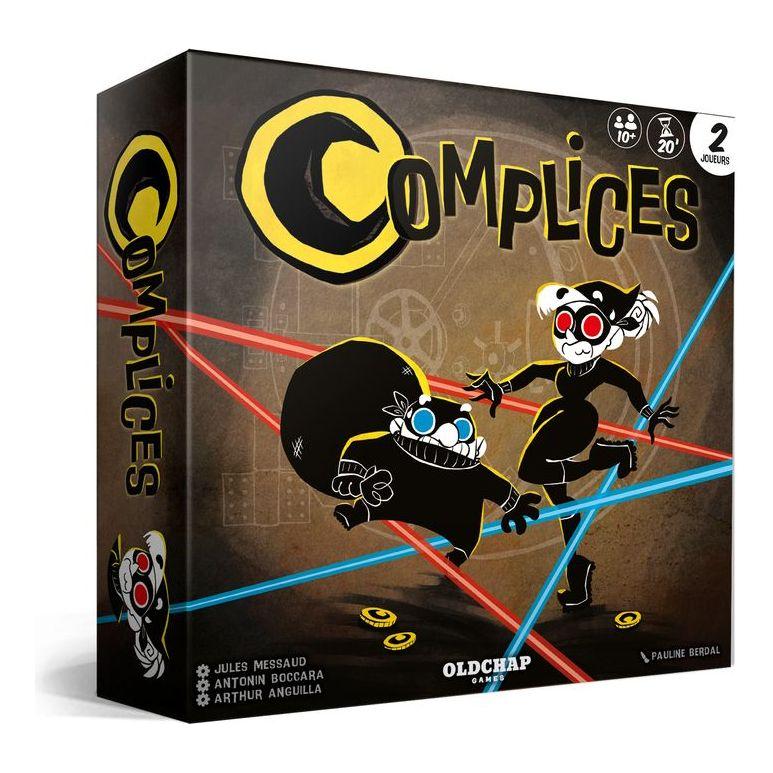
Complices is a real-time cooperative game exclusively for two players, created by Arthur Anguilla, Jules Messaud, and Antonin Boccara, illustrated by Pauline Berdal, and published by OldChap Games. Two apprentice thieves must burgle 4 successive rooms by guiding a marker through invisible lasers — each seeing only a part of the obstacles thanks to their red and blue anaglyph glasses. A completely original mechanical concept, supported by a perfectly coherent heist theme and never-ending tension. Rated 9/10 by the specialized press, one of the best two-player game surprises in recent years.
How to play Complices?
Game Setup
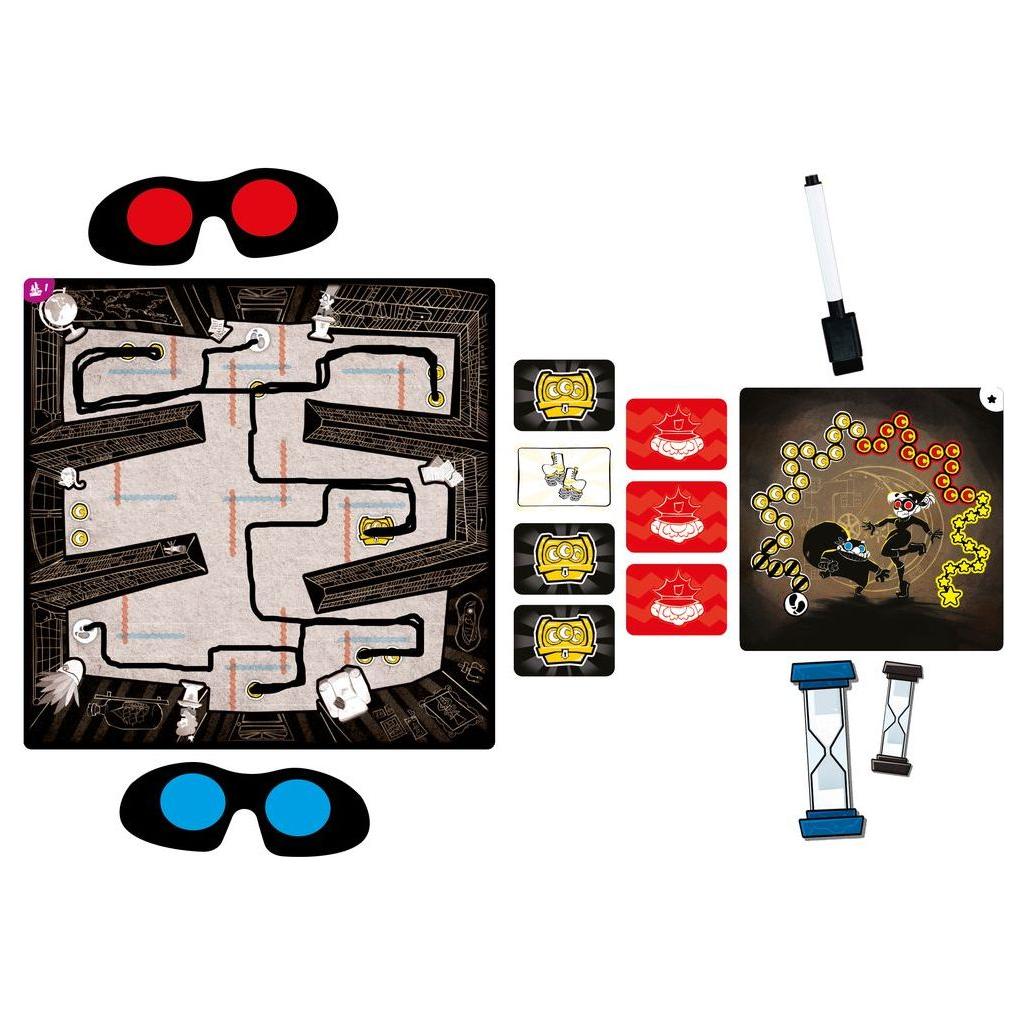
- Choose one of the 4 levels(Mansion, Casino, Museum, final level) and arrange its Room cardsin order.
- Place the active Room sheeton the table with the marker and Treasure tokensin their designated spots.
- Distribute the anaglyph glasses: one player takes the blue glasses(Guide role), the other takes the red glasses(Tracer role).
- Set up the sand timers: 30 seconds for the scouting phase, 2 minutes for the heist phase.
- Any Police tokensare placed on the score track — they are triggered as soon as the duo becomes too efficient.
Gameplay outline
Each room is played in two phases:
- Reconnaissance Phase (30 seconds, without glasses): Both players observe the room together with their bare eyes to memorize its general configuration. The countdown is brutal — 30 seconds disappear at a disconcerting speed.
- Burglary Phase (2 minutes): The glasses are put on. Each player now only sees a portion of the lasers— red for one, blue for the other. The tracer guides the pen in a continuous stroke without lifting the tip, while the guide verbally indicates the tracer's invisible obstacles. The pen cannot cross walls or the black outlines of objects, but can retrace its path or cross its own line. Each treasure reached earns points or a special powerto be used once in the room.
Players alternate rolesbetween each room. Some levels introduce additional specific rules — a die, a new way to collect treasures — which are instinctively understood and renew the experience.
Win/Loss Condition
After completing the 4 rooms in a level, calculate your score by deducting Police penaltiesand lasers crossed. A sufficient score unlocks the next level. Completing all 4 levels in the box is the ultimate challenge of the game.
Our Tips for Winning
-
Establish a common vocabulary from the outset
Communication is the heart of the game. From the very first rooms, agree on precise directive languagewith your partner: "left/right", "up/down", "stop" — short, unambiguous words. The clearer your common code, the faster and smoother your synchronization will be.
-
Memorize the general configuration, not the details
During the 30-second scouting phase, don't try to memorize every laser pixel by pixel. Focus on the overall structure of the room: main corridors, densely trapped areas, and treasure locations. The guide will fill in the details in real time with their glasses.
-
Slow down at the right time rather than rushing in
The urge to draw quickly is instinctive – and a source of errors. In dense areas, the guide must explicitly ask the drawer to slow down. A slow but clean drawing scores many more points than a fast pass full of penalties.
FAQ – All About Accomplices
Do anaglyph glasses really work well?
Yes. The technology is simple but perfectly exploited: each player only truly sees their laser color. The visual partitioning is clean and reliable, and creates exactly the desired tension—your partner sees what you don't, and vice versa.
Is the game really suitable for ages 10 and up?
Absolutely. The rules are one page long and understood from the first room. The initial levels (Mansion, Casino) are designed for a gradual increase in difficulty. It's a universal game that works just as well with 10-year-old children as it does with adults.
Can we play it multiple times with the same rooms?
Yes. Even when you know the layout of a room, the pressure of real-time and the need to coordinate the pathrecreate an authentic tension in each game. Groups looking to beat their record or achieve "perfects" naturally come back for more.
How does the difficulty increase between levels?
The progression is well-paced. The Manor and Casino are accessible from the first few games. The Museum significantly increases in difficulty with denser lasers. The fourth and final level holds a mechanical surprise that the authors have carefully kept secret.