


Concept
Concept
Couldn't load pickup availability
Free delivery on orders over €70
Free delivery on orders over €70
Treat yourself without extra charges. Free delivery for any order of €70 or more via Mondial Relay.
Perfect gift
Perfect gift
Offer an original, durable and characterful product. A perfect idea to surprise your loved ones with a unique creation by Loufoque.
Responsive customer service
Responsive customer service
Questions? Our team will get back to you within 24 hours to assist you before and after your order.
| 4 to 12 players | 40 min | 10 years and + |
Concept is a communication and idea association game for 4 to 12 players, designed by Alain Rivollet and Gaëtan Beaujannot, illustrated by Cédric Chevalier and Éric Azagury, and published by Repos Production. The principle is as simple as it is ingenious: make others guess a word — object, character, place, expression — by placing pawns on the universal icons of a common board, without speaking or miming. Winner of the As d'Or Game of the Year 2014 and selected for the Spiel des Jahres, Concept has become a classic for family and friends' game nights, as addictive for non-gamers as it is for board game enthusiasts.

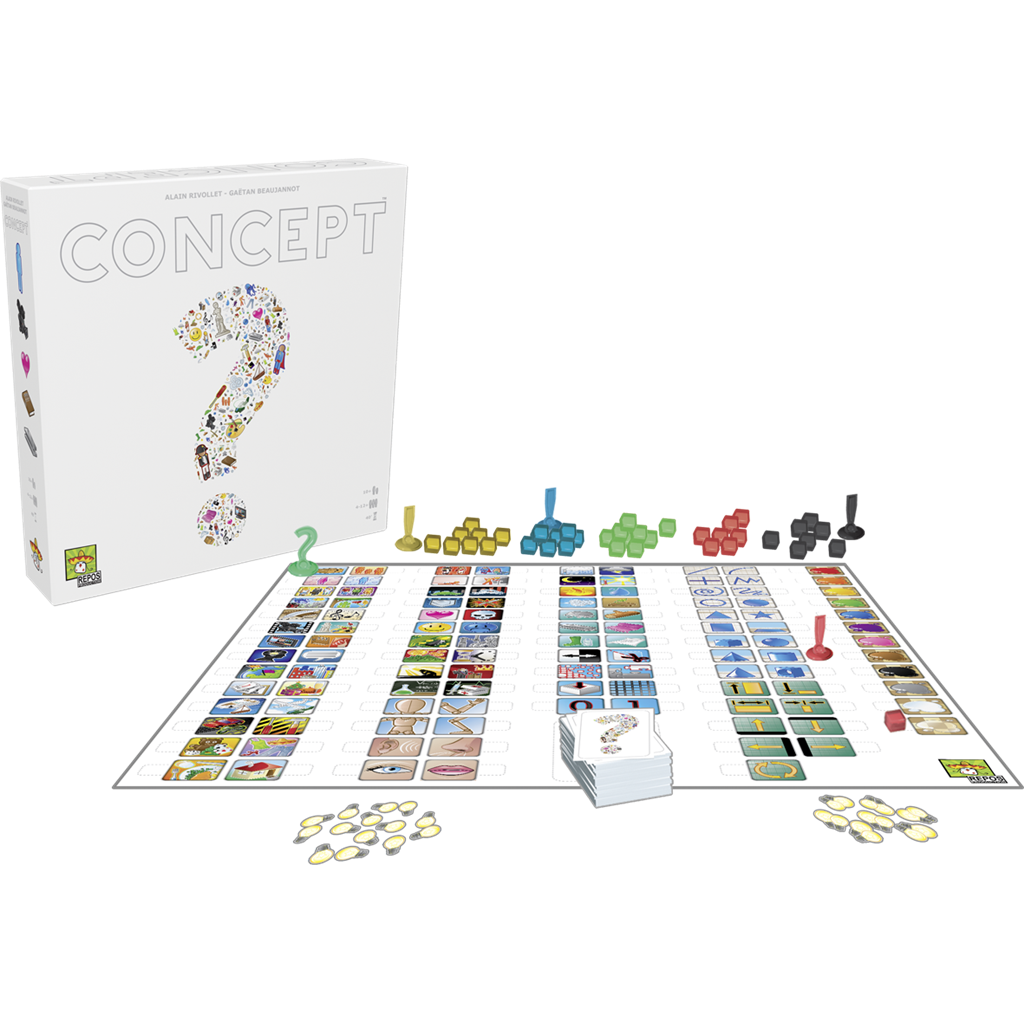
How to play Concept?
Game Setup
- Set up the game boardin the center of the table — it features around a hundred icons divided into categories: nature of the object (animal, plant, building, character...), colors, sizes, materials, actions, places, abstract concepts...
- Place the pawn bowlwithin everyone's reach. The greenpawns (question mark + cubes) are used for the main concept. The coloredpawns (!, colored cubes) are used for complementary sub-concepts.
- Shuffle the 110 Concept cards(990 concepts in total, divided into 3 difficulty levels).
- Designate the first two designers— they are always seated next to each other at the table and play together.
Gameplay outline
- Les deux concepteurs piochent une carte et choisissent en secret l'un des 9 concepts à faire deviner — selon le niveau de difficulté souhaité.
- Ils placent ensuite progressivement leurs pions sur les icônes du plateau pour orienter les autres joueurs. Le pion vert (?) désigne le concept principal : c'est quoi, globalement ? Les cubes verts précisent ce concept (couleur, taille, matière...). Les pions colorés servent à décrire des sous-concepts supplémentaires — par exemple un deuxième élément nécessaire à la compréhension.
- Les concepteurs peuvent réagir aux propositions des joueurs en ajoutant, déplaçant ou retirant des pions. Ils ont le droit de dire uniquement "oui", "non" ou de montrer de l'hésitation — aucune information verbale supplémentaire n'est autorisée.
- Il n'y a pas de limite de temps — Concept n'est pas un jeu stressant. La réflexion collective et les échanges entre joueurs font partie du plaisir.
- Dès qu'un joueur annonce la bonne réponse, il gagne 2 jetons de points, et chaque concepteur en gagne 1.
Win/Loss Condition
The game ends when all 12 double-point tokenshave been distributed. The player with the most points wins the game — although, as the rulebook itself points out, the enjoyment of the game often outweighs the point counting. Many groups simply play for the challenge, with no designated winner.
Our Tips for Winning
-
Tell a story with your pawns
The order in which you place the pawns can powerfully guide players. Start with the broadest concept (animal, building, character...) then gradually refinewith additional cubes. A narrative placement—from general to particular—is always more readable than a simultaneous placement of all icons.
-
Think in concept, not in description
The best designers don't describe the object — they convey the central idea. For "Eiffel Tower": metal building → France → famous. Not: "tall, grey, with small holes."The concept takes precedence over physical description: always ask yourself what best defines the essence of your word.
-
Use sub-concepts to clarify ambiguities
If your main concept points to 10 different words, one or two well-chosen sub-concepts eliminate false leads. A sub-concept "movie"added to a historical figure immediately narrows down the possibilities. Don't underestimate them.
FAQ – All About Concept
Are points really important in Concept?
Not really, and that's one of its charms. The rule itself states that the pleasure of communication takes precedence over competition. Most groups stop counting points after a few rounds—and the games are only longer and more joyful. The points are there for those who want an objective, not as the ultimate goal of the game.
Does it really work with non-players?
That is precisely its superpower. The rules are understood in 30 seconds, the icons are universal and intuitive, and there is no direct competition or penalty. Concept is one of the best gateway gamesout there — it gets passed around the table without resistance, even with people who are not typically into board games.
Can we invent our own concepts outside of the cards?
Yes, totally. Once you've mastered the board, you're free to suggestyour own words, expressions or cultural referenceswithout using the cards. This is how many groups play after a few games - and it's often where the most hilarious moments emerge.
What versions and variations are there?
The range is extensive:Concept Kids(animals to guess, from 4 years old),Concept Disney,Concept Party(compact travel version), and a giant board version for large group activities. Each version adapts the basic concept to a different audience or context.