


Criminal Files: The Murdered Maestro
Criminal Files: The Murdered Maestro
Couldn't load pickup availability
Free delivery on orders over €70
Free delivery on orders over €70
Treat yourself without extra charges. Free delivery for any order of €70 or more via Mondial Relay.
Perfect gift
Perfect gift
Offer an original, durable and characterful product. A perfect idea to surprise your loved ones with a unique creation by Loufoque.
Responsive customer service
Responsive customer service
Questions? Our team will get back to you within 24 hours to assist you before and after your order.
| 1 to 6 players | 120 min | 14 years and up |
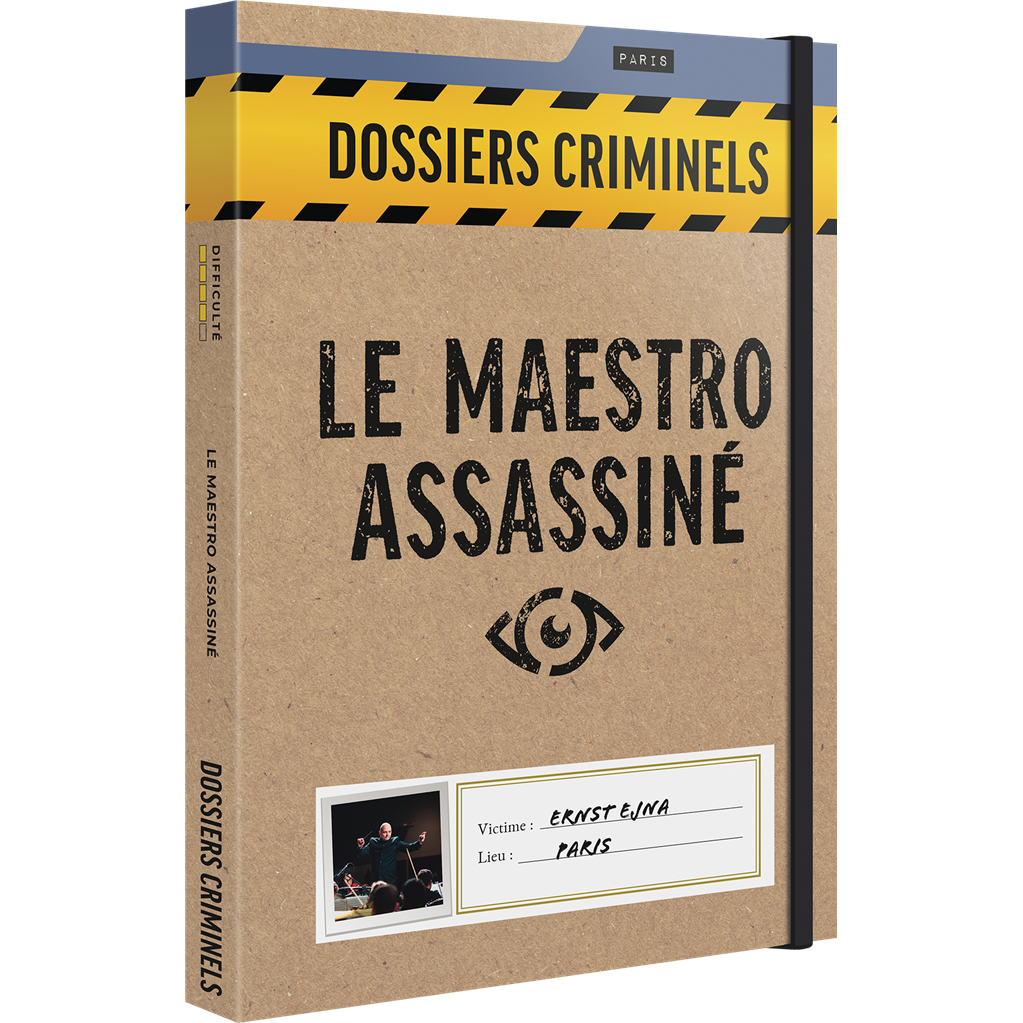
Dossiers Criminels – The Murdered Maestro is an immersive and cooperative board game that plunges you into the heart of a realistic criminal investigation. Ideal for fans of detective games, it offers you the chance to solve a complex case as a team or solo.
In this installment, The Murdered Maestro, the famous conductor Ernst Ejna is found dead in his dressing room. It's up to you to reconstruct the timeline of events, analyze the evidence, examine testimonies, and discover the identity of the murderer.
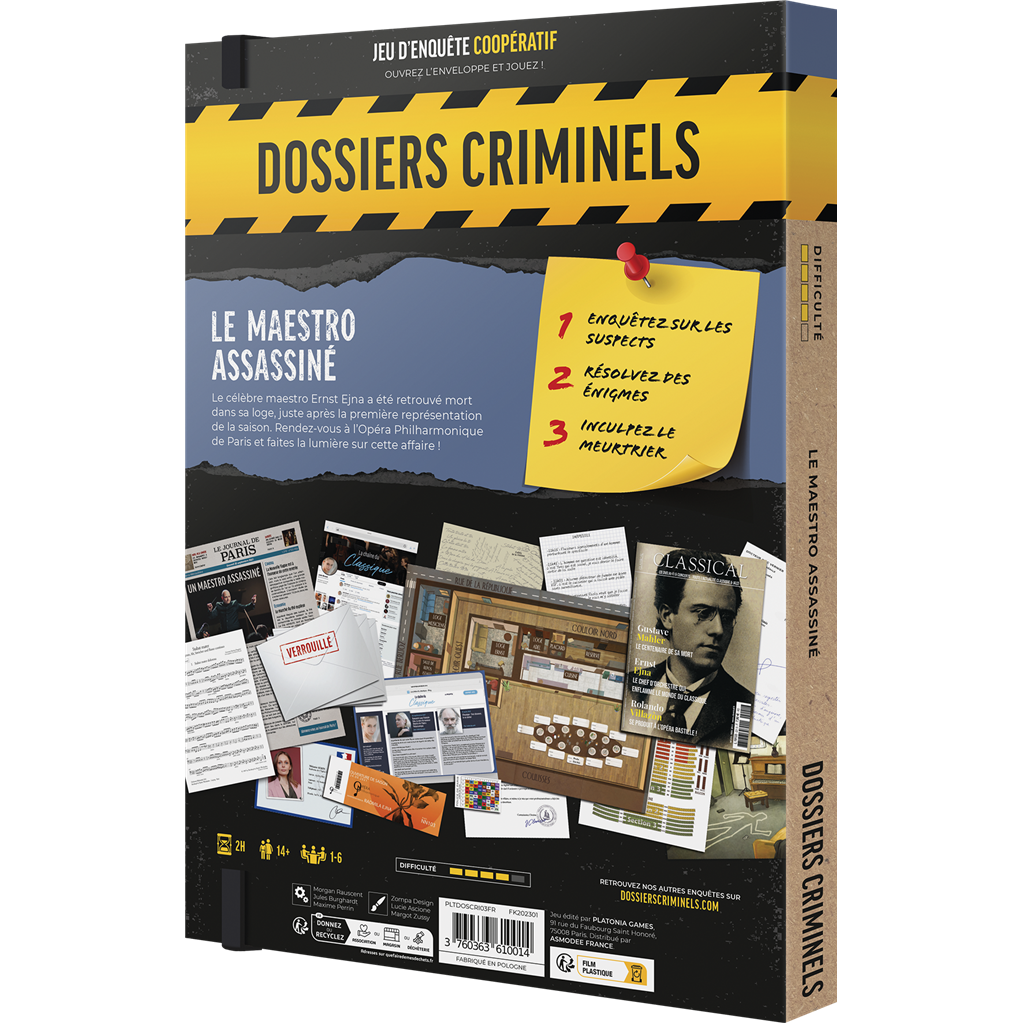
The criminal file contains a wealth of documents to exploit: forensic analysis, newspaper articles, crime scene photographs, audio recordings, and much more. By solving original puzzles, you progressively unlock three sealed envelopes containing new crucial elements for the investigation.
Some steps require an internet connection to hack a computer, unlock a phone, or open a digital safe. To ensure you never get stuck, progressive hints are available online.
Perfect for game nights, fans of narrative board games, and anyone who loves to step into the shoes of a detective!

How to play a Criminal Case collection game?
Game Setup
- Open the folder-box and place all documents (testimonials, journals, village map, etc.) on the table.
- Ensure you have internet access ready for the digital phases (investigation website or blog).
- Together, define a work system (task distribution, document review, note-taking) and prepare to meet the challenge.
Gameplay outline
- Initial moments: go through all available clues without opening the sealed envelopes.
- Solve the proposed puzzles that will unlock the four envelopes: each contains new essential evidence for the rest of the investigation.
- Use online access to consult additional resources (blog, IDs to hack, dedicated website) and avoid any blockages.
- Gather the evidence, cross-reference testimonies, establish a timeline, identify suspects, and rule out false leads.
Win/Loss Condition
- Once all the evidence has been gathered and the four envelopes opened, answer the final questions in the file.
- If your team manages to formulate a theory consistent with the collected evidence, the case is solved.
- Conversely, an incomplete or incorrect theory will lead to a defeat: the mystery remains unsolved.
Our Tips for Winning
-
Clearly define roles from the start
Assign a lead reader, a digital tracker, a document archivist, and a final reviewer: this ensures all media are covered effectively and progress is made without bottlenecks.
-
Leverage internet access as a strategic tool
Digital investigation is an asset: use it as leverage to gain additional clues, but be sure to leave room for future puzzles.
-
Consider alternative approaches
If a theory seems to be stagnating, explore the less obvious details: an overlooked document or an ambiguous mention may hold the key to the mystery.
FAQ – All About Criminal Records
Can it be played solo?
Yes. The game is designed for 1 to 6 players, allowing for solo or group play.
Are there complex rules to read before starting?
No. The "cold case file" format is intuitive: open it, browse through the documents, follow the puzzles, and make progress. There are no cumbersome rules to learn.
Is internet access mandatory?
Yes. A connection is required to take full advantage of the digital investigation (blog, website, online clues).
Is the equipment reusable or single-use?
The game is designed to be replayable as long as the materials are not damaged: there's no mandatory cutting, so you can investigate again or lend it to someone else.