


Double Seven
Double Seven
Couldn't load pickup availability
Free delivery on orders over €70
Free delivery on orders over €70
Treat yourself without extra charges. Free delivery for any order of €70 or more via Mondial Relay.
Perfect gift
Perfect gift
Offer an original, durable and characterful product. A perfect idea to surprise your loved ones with a unique creation by Loufoque.
Responsive customer service
Responsive customer service
Questions? Our team will get back to you within 24 hours to assist you before and after your order.
| 2 to 4 players | 20 min | Ages 8+ |
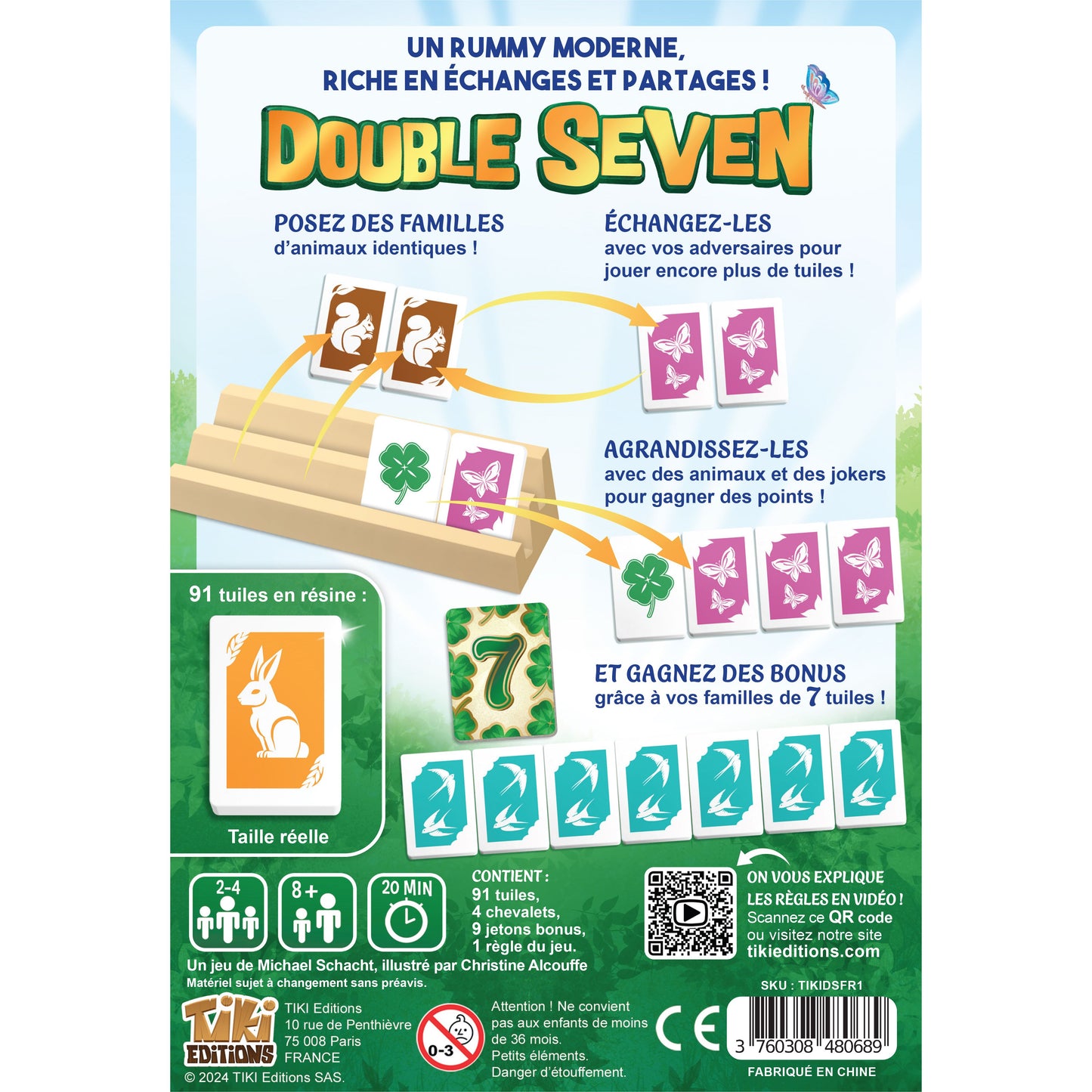
Double Seven is a tile-laying and collection game for 2 to 4 players, designed by Michael Schacht—creator of Lucky Numbers—and illustrated by Christine Alcouffe. Inspired by familiar Rummy mechanics, it adds an original tactical layer: exchanging entire families between players, which can turn the tide of the best collections at the last moment. With its 91 acrylic tiles featuring colorful animals, Double Seven establishes itself in just 20 minutes as a game that is as pleasant to handle as its gameplay is fluid.

How to play Double Seven?
Game Setup
- Shuffle the 91 Animal tilesface down and place them in a common draw pile in the center of the table.
- Distribute a screento each player to hide their tiles.
- Flip 1 tile face upin the center to start the game.
- Designate the first player.
Gameplay outline
In your turn, you perform 4 steps in order:
- Flip a tileface up in the center, if there isn't one available.
- Draw tiles: take 2 tiles(face up or face down) if you already have at least one tile on your easel, or 3 tilesif your easel is empty. If you have 5 or more tiles all representing different animals, announce "Rainbow"to show your easel and draw an additional tile.
- Perform as many actions as you wish, in the order of your choice: place an animal family on the table, expand an existing family (yours or an opponent's), or swap one of your placed families for an opponent's family that has the exact same number of tiles.
- Pass your turnto the next player.
Win/Loss Condition
The game ends as soon as a player achieves the "Double Seven"— meaning two sets of 7 tiles laid down. The final score takes into account:
- 1 point per tile laidon the table.
- +1 pointfor each set of 7 tiles (Seven bonus).
- +2 pointsfor the player who triggered the end of the game with their Double Seven.
The player with the highest scorewins.
Our Tips for Winning
-
Build your families the right way from the start
Place your first families with consistent animalsthat you can easily expand. Placing too small a family too early exposes you to an unfavorable exchange: your opponent can take it from you with a collection of the same size.
-
Protect your large families by expanding them even further
An opponent can only trade a family with a collection of strictly identical size. The best protection is therefore to constantly expand your familiesto make them difficult to duplicate. A family of 8 or 9 tiles is practically untouchable.
-
Use the exchanges offensively, not just defensively
Trading is not just a survival tool: it's a tactical weapon. If an opponent is close to Double Seven, stealing their largest family at the right moment can completely derail their plan and give you a surprise victory.
FAQ – Everything You Need to Know About Double Seven
Is Double Seven really that different from Lucky Numbers?
Yes, despite the same author and publisher. Lucky Numbers is based on logic and ascending order. Double Seven is more focused on collection, exchange, and direct interaction. The two complement rather than compete with each other.
Is the element of chance too great?
It is present—tiles are drawn face down—but the choices of placing, swapping, and protecting your familiesoffer enough control that the best players consistently do better. It's a family game, not a strategy tournament.
Can you play with young children under 8 years old?
The rules are simple, but the notion ofconditional exchange(same number of tiles) can be unsettling for children under 7. From 7 years old, with good accompaniment, the game remains perfectly playable.
Does Double Seven work well with 2 players?
Yes, but the experience changes. With 2 players, interactions are more direct and every decision is immediately noticeable. With 4 players, the chaos of cross-talkbetween multiple players makes the game more unpredictable and often more fun.