


Lucky Numbers
Lucky Numbers
Couldn't load pickup availability
Free delivery on orders over €70
Free delivery on orders over €70
Treat yourself without extra charges. Free delivery for any order of €70 or more via Mondial Relay.
Perfect gift
Perfect gift
Offer an original, durable and characterful product. A perfect idea to surprise your loved ones with a unique creation by Loufoque.
Responsive customer service
Responsive customer service
Questions? Our team will get back to you within 24 hours to assist you before and after your order.
| 1 to 4 players | 20 min | 8 years and up |
Lucky Numbers is a tile-placement game for 1 to 4 players, designed by Michael Schacht and illustrated by Christine Alcouffe. Halfway between Bingo and Sudoku, each player draws numbered clover tiles and places them in their 4×4 garden, with one simple rule to follow: each row and each column must be in strictly increasing order. Simple to explain in under a minute, terribly addictive, intergenerational from age 8 – Lucky Numbers has become a family game library staple since its colorful re-release by Tiki Editions.

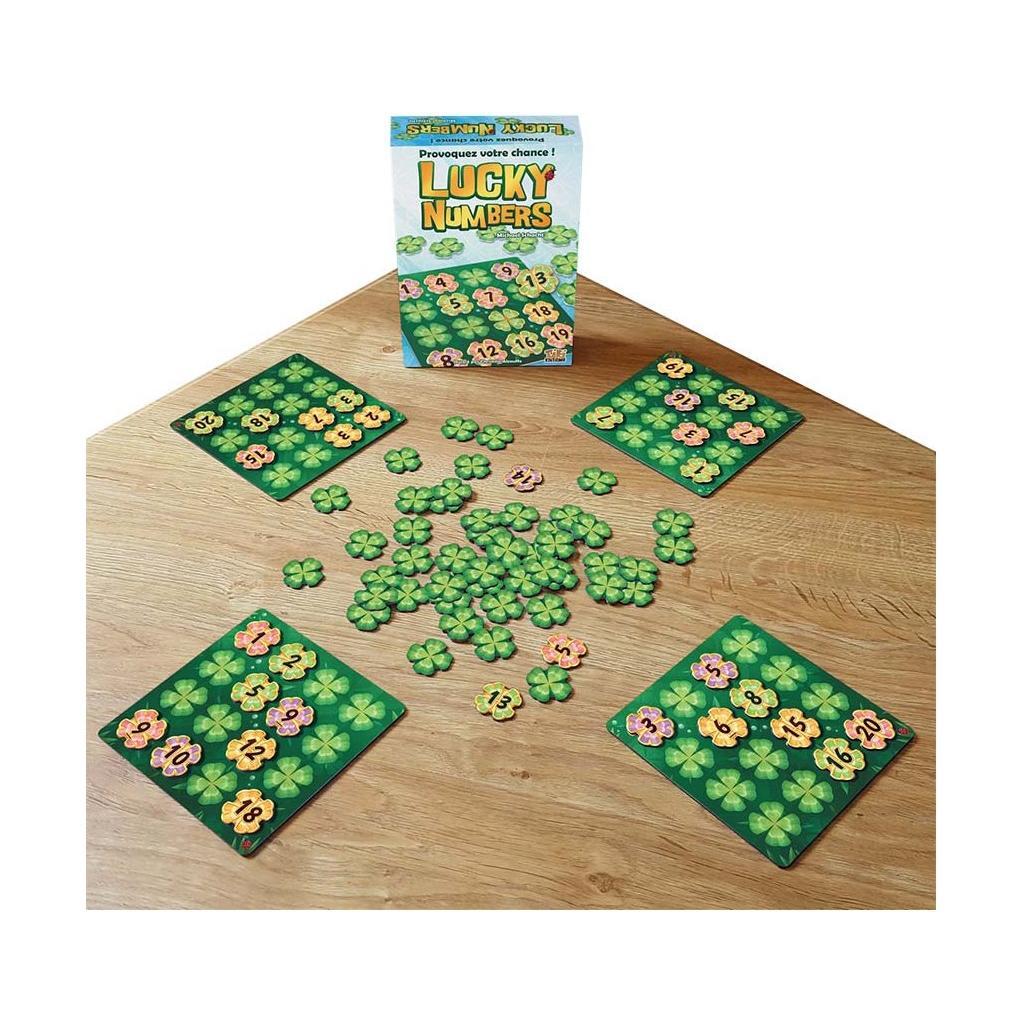
How to play Lucky Numbers?
Game Setup
- Chaque joueur choisit une couleur et reçoit un plateau Jardin 4×4 et la série de 20 tuiles trèfles numérotées de 1 à 20 correspondant à sa couleur.
- Picochez 4 tuiles face visible au hasard dans votre propre série et placez-les dans les 4 cases diagonales de votre jardin (haut-gauche à bas-droite), dans l'ordre croissant.
- Mélangez les tuiles restantes de toutes les couleurs et formez une pioche commune face cachée au centre de la table.
- Désignez le premier joueur : le jeu peut commencer immédiatement.
Gameplay outline
On your turn, you choose one of two actions:
- Draw a face-down tilefrom the common draw pile and place it face-up in your garden, in any empty space, provided that its row AND column remain in ascending order(empty spaces count as allowed gaps).
- Take the visible tilefrom the common discard pile — if a tile is available there — and place it according to the same rules.
If you cannot or do not wish to place your tile, you discard it face-upin the center for other players to use on the next turn.
Bruno Cathala Variant(included in the box): if you place a tile with a number identical to a diagonally adjacent tile, you immediately play again. An excellent way to catch up on luck.
Win/Loss Condition
The first player to fill all 16 spaces in their gardenin ascending order wins the game. The victory is immediate and often triggers an instant rematch.
Our Tips for Winning
-
Start by placing your low cards in the top left
When setting up, position your low numbers in the top and left squares, and keep the bottom and right squares for high numbers. This filling logic avoids blockages in the middle of the game when medium tiles become difficult to place.
-
Never discard a tile that would be useful to your opponent
Before discarding a tile, check if it directly fills a gap in your neighbor's garden. Sometimes, keeping an unplayable tileis better than offering it on a silver platter — literally.
-
Activate the Bruno Cathala variant right from the first game
This variant doesn't make the rules more complicated but intelligently rebalances the element of chance. The possibility of replaying by placing two identical diagonal numbers creates tactical situations that are clearly missing from the basic version. Don't miss out.
FAQ – All About Lucky Numbers
Is Lucky Numbers truly a game of chance, or can it be mastered?
Both, honestly. The draw introduces an element of luck that nothing can completely bypass. But the choice of placement, discard management, and reading the opponent's gardenoffer enough strategic decisions that games are never just about pure luck.
Does the Bruno Cathala variant really change the experience?
Yes, significantly. Without it, the game can feel a bit hollow for players used to having more control. With it, the ability to replay in chainson diagonals adds a welcome tactical dimension and unexpected twists. It is officially included in all recent editions.
Is the solo mode with the 40 puzzles really satisfying?
This is a distinct mode, different from multiplayer. It involves solving partially filled gridswith a limited number of moves — more like a logic puzzle than a game of chance. Ideal for training or playing alone in the morning with your coffee.
Is Lucky Numbers suitable for children younger than 8 years old?
Exactly. The rules are reduced to counting and ordering numbers from 1 to 20, so children as young as 6 who are comfortable with numbers can play without difficulty. It's even a good playful excuse to work on ascending order with younger children.