


Moon Colony Bloodbath
Moon Colony Bloodbath
Couldn't load pickup availability
Free delivery on orders over €70
Free delivery on orders over €70
Treat yourself without extra charges. Free delivery for any order of €70 or more via Mondial Relay.
Perfect gift
Perfect gift
Offer an original, durable and characterful product. A perfect idea to surprise your loved ones with a unique creation by Loufoque.
Responsive customer service
Responsive customer service
Questions? Our team will get back to you within 24 hours to assist you before and after your order.
| 1 to 5 players | ~45 min | 14 years and up |
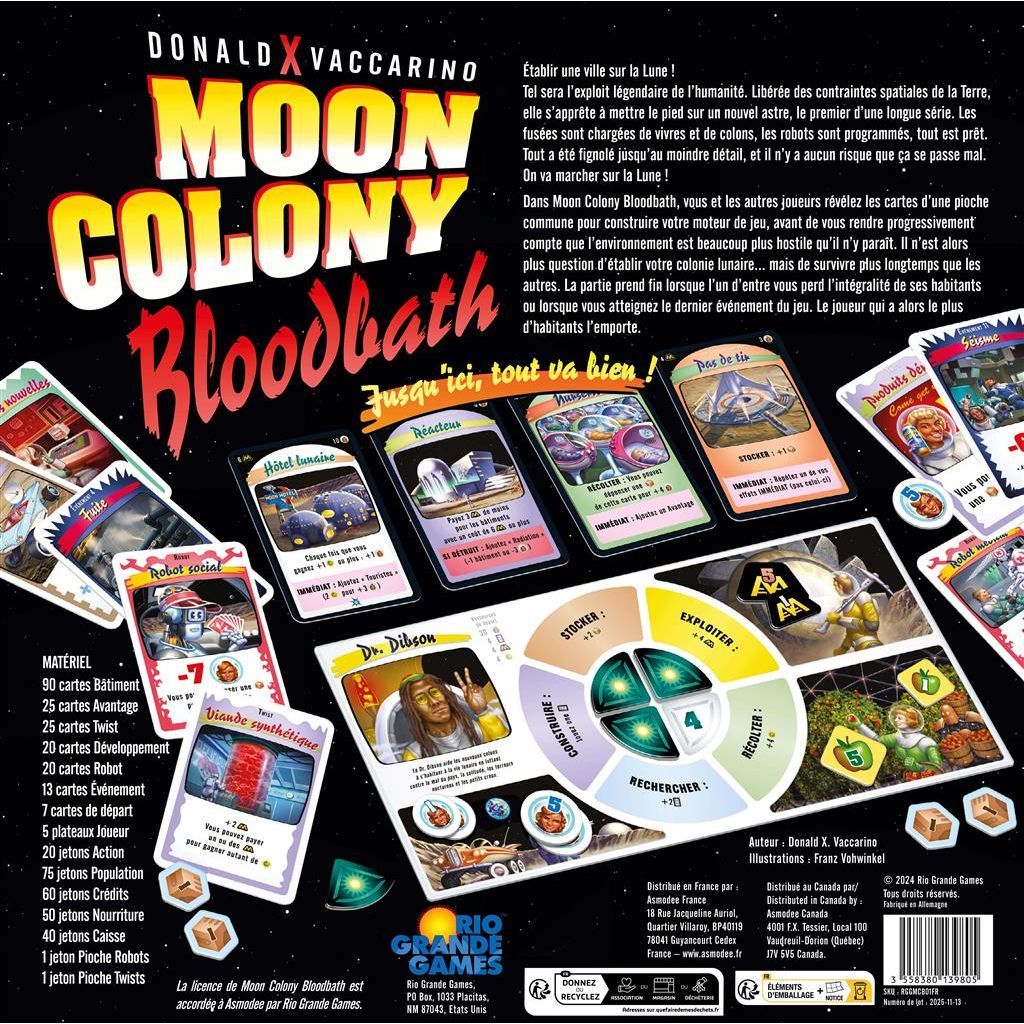
With Moon Colony Bloodbath, take control of a lunar colony in a base management game that is as strategic as it is crazy. Your mission: develop your space installation, recruit colonists, and survive the disasters that regularly strike the Moon. Between resource management, building optimization, and unpredictable events, each game becomes a permanent struggle to keep your colony alive. This game skillfully blends strategy, dark humor, and controlled chaos.

How to play Moon Colony Bloodbath?
Game Setup
Install the central board and the different card stacks. Deal a starting base to each player. Prepare the necessary resources, dice, and tokens. Shuffle the Event cards that will trigger lunar disasters.
Gameplay outline
- The game revolves around a shared deckthat is progressively revealed. Each turn, a card from the deck is flipped over, and its effect applies to all players simultaneously.
- When a Workcard appears, each player chooses one action from several possibilities:
mine to earn money, produce food, research new cards, build a structure, or reactivate certain effects in their colony. - When a Problemcard is revealed, the situation deteriorates: shortages, industrial accidents, killer robots, or technical failures strike the colonies, often causing loss of population or buildings. These cards then remain in the deck, making subsequent rounds increasingly dangerous.
- Players can also add new Development or Perk cards to the deck to improve their colony or gain personal bonuses. But the larger the deck becomes, the more regularly disasters occur. All the game's tension lies in this balance between development and survival.
Win/Loss Condition
The game ends when a player loses all their population or when the event deck runs out. The winner is the player with the most survivors in their lunar colony.
Our Tips for Winning
-
Build a simple yet sturdy engine
In Moon Colony Bloodbath, trying to optimize everything can be dangerous. The most complex colonies are often the first to collapse when disasters strike one after another. It's better to build a compact economic engine that can withstand repeated crises.
-
Prioritize food and people
Your population represents both your strength and your victory condition. Producing enough food and protecting your people quickly becomes more important than building very powerful but fragile buildings.
-
Anticipating the return of Issue cards
Disasters never truly disappear as they regularly return to the common deck. Therefore, it is essential to anticipate future turns rather than just playing for the short term.
FAQ – All about Moon Colony Bloodbath
What kind of game is Moon Colony Bloodbath?
This is a management and tableau-building game in which players develop a lunar colony while surviving a series of increasingly violent disasters.
What is "destructive engine building"?
Unlike traditional management games where your engine constantly grows more powerful, Moon Colony Bloodbath gradually destroys your facility. Negative events disrupt or ruin your development throughout the game.
Is chance a big factor?
Yes, luck plays a significant role through the cards revealed in the shared deck. However, resource management and anticipation allow for better crisis survival.
Is there a lot of player interaction?
Direct interaction remains limited. Players mostly experience the consequences of the common deck together, which sometimes gives the game a semi-cooperative feel despite its competitive system.